The points
You will also see them written by other names — same points, different naming systems. They are worth knowing by both names so you can look them up elsewhere.
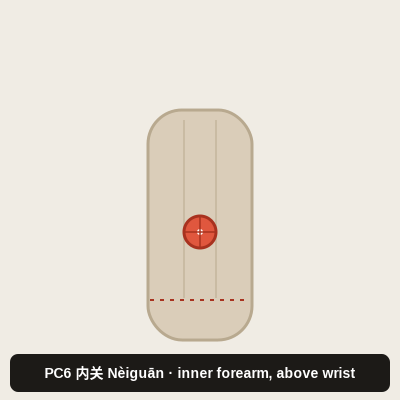
PC6 — Neiguan
内关 · inner forearm, above wrist
A staple of travel and calming routines in traditional practice.
How you know you are on it: A sore, faintly tingly feeling between the two tendons, sometimes reaching the palm.
What people miss: Landing on the wrist crease itself. Measure three finger-widths up from the crease first, then press.
ST36 — Zusanli
足三里 · below knee, outer shin
A classic point used in traditional routines for everyday vitality.
How you know you are on it: A deep ache that can run down toward the foot.
What people miss: Pressing straight onto the shin bone — that is painful, not useful. Slide one thumb-width outward, onto the muscle.
What this can and cannot do
A travel-band or firm ring worn at the same spot is a common companion, which is why this one works in a car or on a plane.
✈️ Travelling soon?
The same point — PC-6, Nèiguān — anchors a whole travel-day routine: what to do in the car, on takeoff and landing, and on day one in a new time zone. There is a separate page for it, with an 18-second wrist demo you can watch.
🤱 Queasy mornings during pregnancy?
When the usual options feel off-limits, many people keep using exactly this wrist routine — the wristbands sold for morning sickness press the same spot (P-6, between the tendons). It is a comfort habit some people find settling, not a treatment. Every pregnancy is different, so check with your doctor before adding anything new, even something this gentle.
Questions people ask about acupressure for nausea
Does acupressure really help with nausea?
PC6 is the point most often studied for queasiness, and the evidence is mixed: some trials find it settles mild queasiness, others find little difference from a placebo band. Treat it as a comfort routine some people find settling, not a treatment.
Where exactly is the P6 (PC6) point?
Three finger-widths above the wrist crease, on the inner forearm, between the two tendons. Measure up from the crease first - landing on the crease itself is the most common miss. Press with your thumb for about 30 seconds; a sore, faintly tingly feeling means you are on it.
How long does it take to feel something?
People who find it useful usually describe a settling feeling within a few minutes of steady pressure. If queasiness is severe, keeps coming back, or comes with other symptoms, that is a practitioner conversation, not a pressure-point one.
Is it safe during pregnancy?
The wristbands sold for morning sickness press this same spot, and many people keep the routine during pregnancy. Every pregnancy is different, so check with your doctor before adding anything new, even something this gentle.
This page is the index. The full plan is $59.
The points above are free to read and always will be. What costs money is the sequence and the timing — how long to hold each one, in what order, paired with which gua sha area, on which day.
- 21 evenings, each with a clear diagram
- 2 points + 1 gua sha area + a soak or drink per evening
- 3 weeks in order, so nothing gets skipped or repeated
- 4 hand-demo videos — see the press, not just read it
- One-time purchase, yours forever